Best Chokes for Turkey Hunting: Turkey Choke Guide & Top Picks
A no-nonsense guide to choosing the best turkey choke for your shotgun. When a longbeard hangs up at 42 yards, you should know exactly what to expect with your gun.
April 08, 2026



BIG SAVINGS
+EVERYTHING SHIPS FREE
Learn More
If you're chasing spring gobblers, the right choke matters just as much as camo patterns, decoy strategy and call technique. You're aiming for the vulnerable area between the turkey's neck or head, and when your target is 30 to 50 yards away, that's a small target and it's moving. The closer you can bring them in with realistic turkey decoys and strategic calling, the more forgiving your pattern becomes.
The right choke paired with the right load stacks pellets where they count and turns your shotgun into a lethal turkey setup.
Put these best practices to work before your next patterning session or turkey hunt.
In simple terms, a turkey choke is a tighter constriction at the muzzle. It keeps the shot column together longer so more pellets reach the target simultaneously.
Compared to a standard full choke, an extra-full or turkey-specific choke produces a denser pattern. That extra pellet concentration fills in the gobbler's small kill zone and reduces the chance of gaps in your pattern.
Turkeys aren't pass-shooting ducks. Shots are deliberate. Ranges can stretch. Precision matters. A quality turkey choke gives you consistent, repeatable pellet placement at typical spring distances.
- Choke equals controlled constriction.
- Extra-full equals more pellet density.
-Your goal is even coverage in the head and neck.
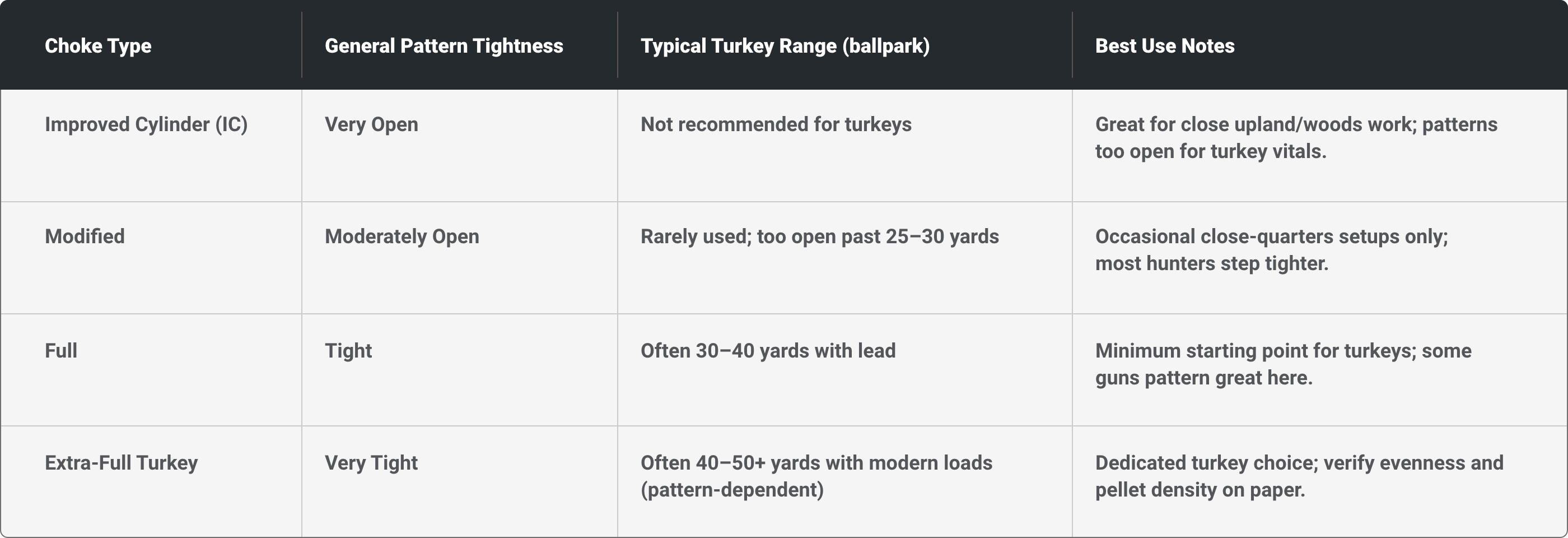
Choke constriction controls pattern spread and, with it, ethical range. In broad strokes, the tighter the choke, the farther you can reliably place pellets into the turkey's head or neck. However, keep in mind that patterns must stay even, not just tight.
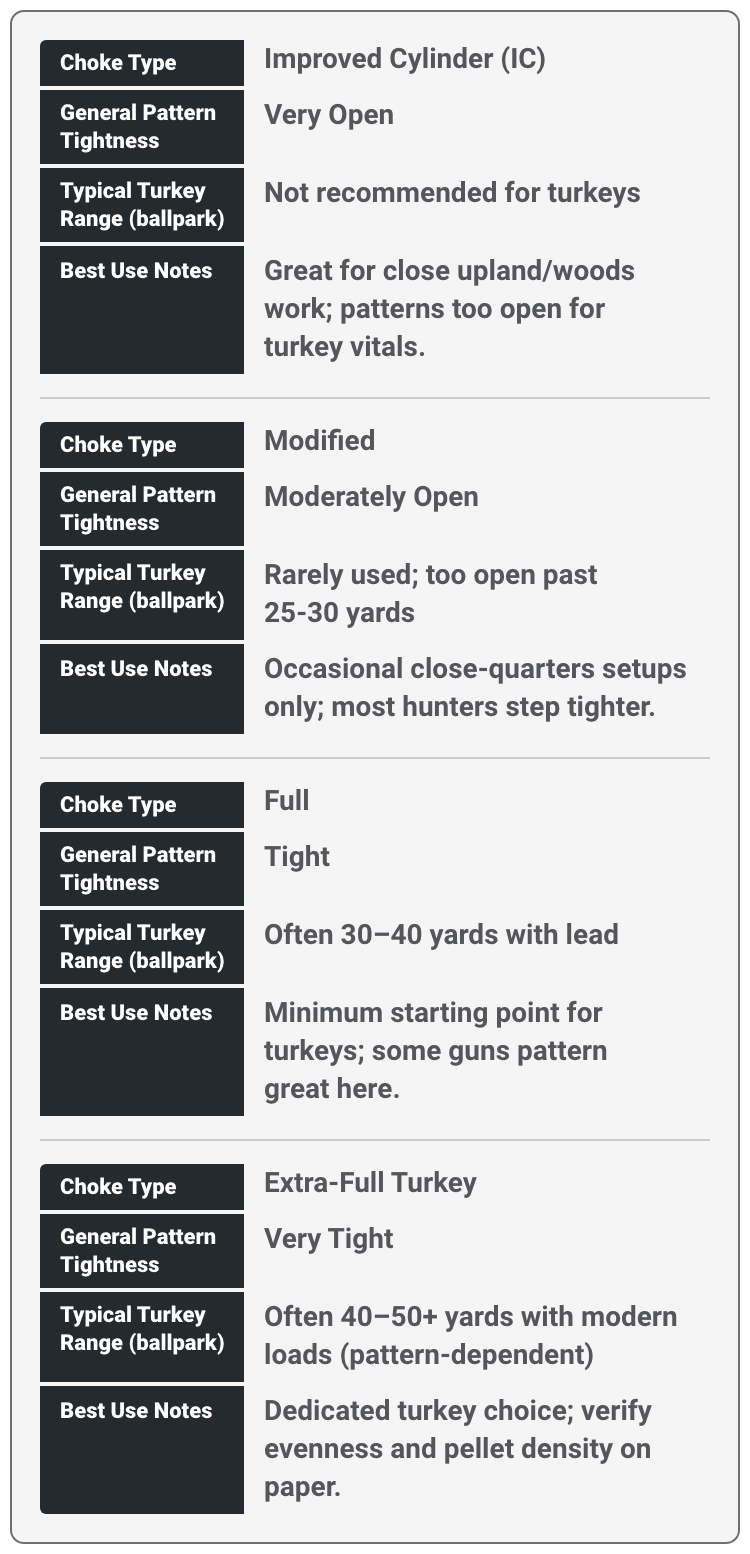
Here's a common scenario hunters often see. Of course, your individual results will vary depending on your specific shotgun, choke tube and load. Paper will always tell you the truth; this table simply frames what most hunters see.
Keep in mind, a super-tight pattern doesn't necessarily mean better. You're aiming for dense and even, without patchy voids that let a bird slip through at 40 yards. That balance is what patterning confirms before opening morning.
If you want consistent performance at 30-50 yards, understanding turkey choke tube types and materials is critical. The wrong tube can cost you pattern density or worse, damage your barrel. The right one turns your shot gun into a precision turkey tool. Turkey chokes come in two main styles: flush-fit and extended configurations. Flush tubes sit even with the muzzle, while extended tubes protrude and usually include a knurled end for easy swaps. Extended tubes are popular for turkey hunting because they're easy to change at the range and often pattern more consistently due to a longer parallel section.
Some turkey chokes are ported. Porting can soften muzzle rise slightly and may reduce perceived recoil for some shooters, but its real-world impact on pattern uniformity varies by gun and load. Many hunters prioritize whatever patterns bestported or notthen stick with it.
Materials matter, too. Quality turkey chokes are typically built from corrosion-resistant metals like 174 stainless steel or a similar chrome-alloy steel. These alloys stand up to heavy spring weather, frequent cleaning, and high round counts without galling or rusting.
Finally, pay attention to compatibility. Many tubes are labeled for specific shot types: lead only, lead and HeviShot, or TSSrated. Always match the choke to your shot material and confirm the correct thread pattern for your shotgun (for example, rem-style vs. other systems).
Your gauge and ammunition matter as much as constriction.
Offers the most flexibility. Extra-full turkey chokes paired with premium lead or tungsten loads are both common and effective.
Has become extremely capable with modern tungsten blends. A dedicated turkey choke keeps patterns tight in a lighter platform.
When selecting ammunition, compare available turkey shotgun ammo options here.
When paired with TSS and a dedicated turkey choke, it can be surprisingly effective at conservative ranges. Lead loads may pattern best with slightly less aggressive constrictions in some guns. Tungsten and TSS often handle tighter constrictions effectively. Always follow manufacturer recommendations and test your combination on paper.
Terrain matters too. In tight timber, a forgiving pattern inside 35 yards is ideal. In open fields, you may want a setup capable of 40 yards or slightly more if your pattern holds together. Strategic positioning and quality turkey calls help bring birds into your ideal range so you're not stretching your pattern beyond its limits.
These are reliable options commonly carried by Sportsman's Guide and trusted by turkey hunters.
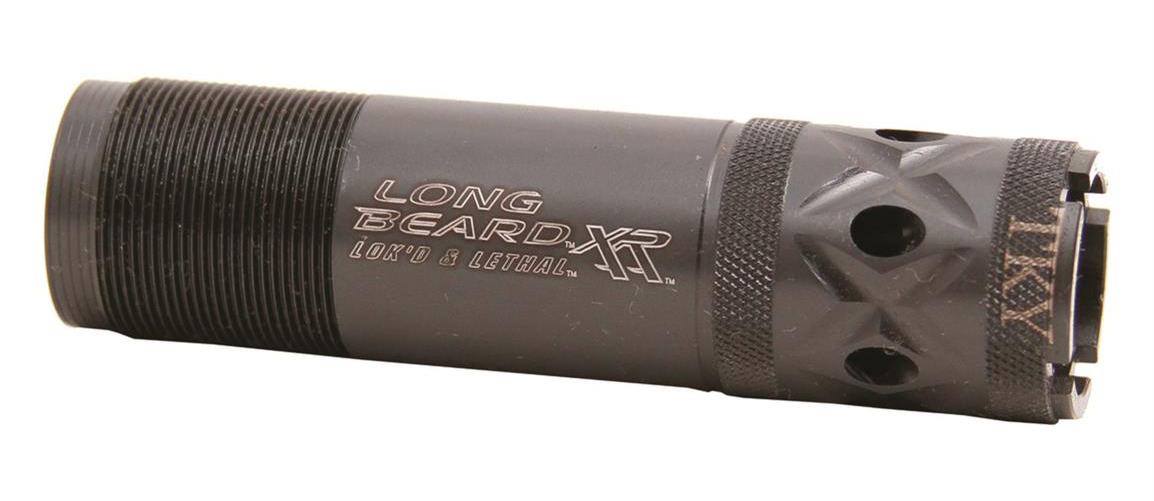
This option is pattern-tested for dense performance with lead and heavier shot. The Long Beard Ported Turkey Choke 12 Gauge is a classic extra-full turkey choke trusted by hunters.
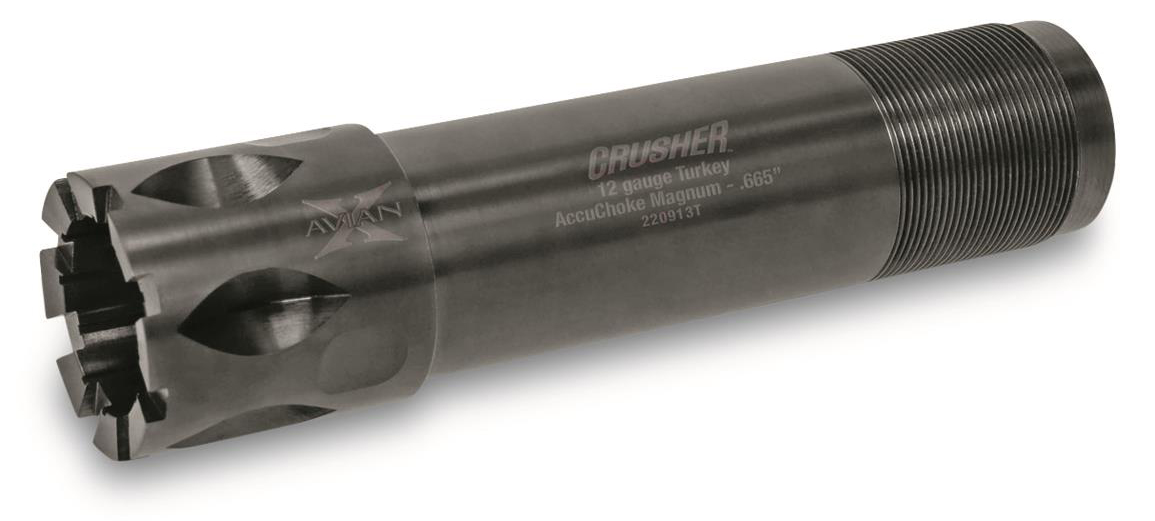
The Avian X Turkey Chose Tube is built for maximum pattern density and extended range. Rated for multiple shot types depending on model. A strong option for hunters looking for tight, consistent patterns.
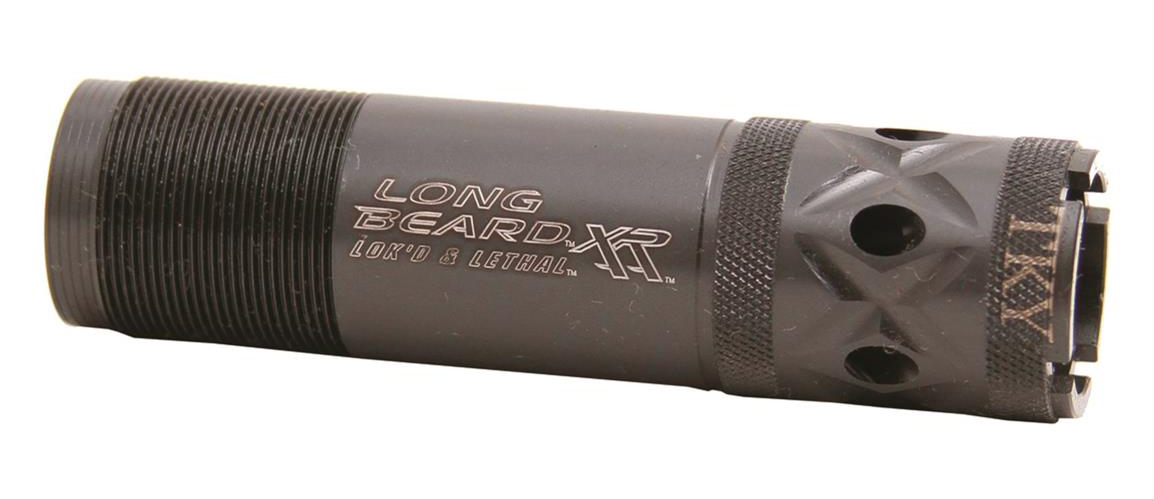
The 20-gauge option offers the same proven performance as the 12 gauge, but in a lighter 20-gauge version.
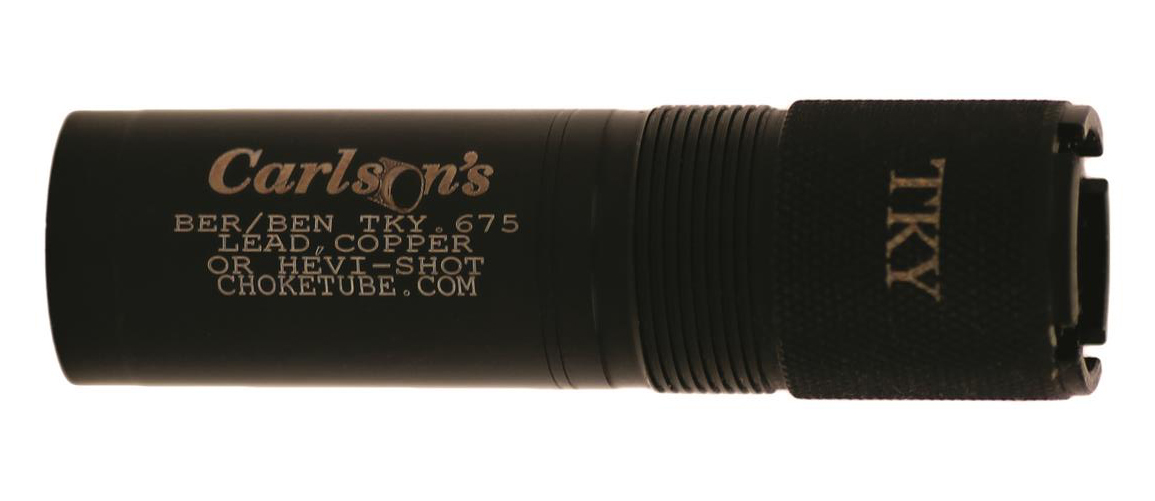
Extended design for easy swaps and tight, Carlson's 12-gauge Extended Turkey Choke Tubes has consistent patterns at turkey ranges
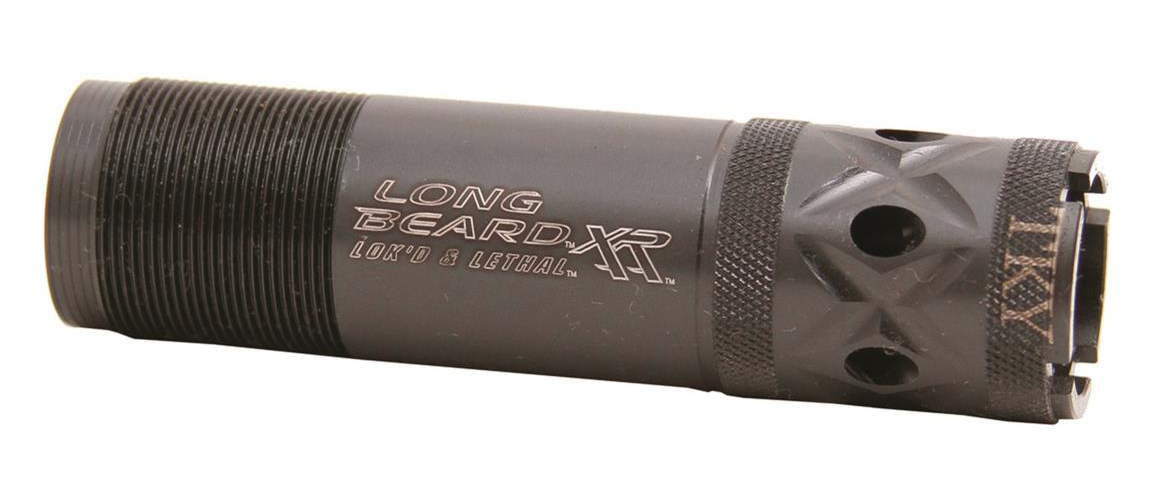
The Long Beard XR pairs particularly well with Winchester loads, but also performs well with other lead loads. It's known for strong pellet density and dependable patterns in 12 and 20 gauge options.
Patterning turns guesswork into confidence. It shows you exactly where your pellets land and how far you can shoot ethically. Set aside an afternoon, grab a few different loads, and let the paper decide which turkey choke and ammo combo will be a staple in your vest.
Use a solid rest, a safe backstop, and large targets. Turkey-specific targets are helpful, but a 30inch circle drawn around point of aim works just as well. A rangefinder makes distance checks easy, and a benched shooting rest helps eliminate human error.
Start close and move back in stages. You'll confirm your initial point of impact, then evaluate pellet density and evenness at your true hunting ranges.
Count head/neck hits to judge lethality and scan the entire 30inch circle for even coverage.
Adjust your setup if you're seeing sparse sections or big voids.
Your ethical range ends where pattern density and evenness no longer deliver reliable head/neck strikes. Stick to that distance in the woods every bird deserves a clean, quick end. Once you've defined your max distance on paper, take time to apply it in the field. Smart setup, calling discipline, and decoy positioning can help you pull birds comfortably inside that range our spring turkey hunting tips break down practical tactics that work in real Woods.
1. Gather gear: turkey targets (or paper with a 30-inch circle), safe backstop, eye/ear protection, benched shooting rest, rangefinder, grease for choke threads, and a few different loads rated for your choke.
2. Confirm fit: ensure the choke matches your shotgun's thread system (for example, Beretta/Benelli Mobil) and is rated for your shot type (lead, Hevi-Shot, or TSS). Lightly grease the threads and snug the choke per the manufacturer.
3. Zero at 1015 yards: fire one shot to verify point of impact and confirm you're centered on the target. Adjust sights or optics if needed.
4. Step back to 25-30 yards: shoot a fresh target. Evaluate head/neck hits and look for even Distribution no large gaps.
5. Move to 40 yards: this is the common benchmark. Fire at least two groups with the same load to confirm repeatability, then try a second load or different constriction if you need more density or smoother coverage.
6. Count and compare: tally strikes in the head/neck and scan the full 30-inch circle. You want a dense, even pattern with overlapping hits in vitals and no fist-sized holes.
7. Decide your max range: if the 40-yard pattern is solid, test farther only if you might take those shots. Stop where density and evenness fall off note that distance as your ethical limit.
8. Document your winner: record gun, choke, load, yardage and results. Bring the proven combo to the turkey woods, and make sure your turkey hunting vest keeps your extra tubes and shells organized for quick adjustments.
For a deeper breakdown of the process, review our guide on how to pattern your shotgun for turkey hunting.
We've all seen these mishaps at camp. None are fatal to your hunt, but they can cost you a gobbler or, worse, damage a shotgun. A little prevention goes a long way.
Start by matching the choke to your load. Many turkey chokes are clearly marked for lead only or lead/HeviShot. Some are TSSrated; others are not. Resist the urge to cram an incompatible shot through a tight tube.
Treat your choke like a critical piece of precision gear with regular maintenance. Threads need grease, fit needs verification, and patterns need a onceover each spring.
Still have questions? Here are quick, practical answers to the most common turkey choke questions we hear in the spring and around the range.
A few things to keep in mind:
These responses keep things simple and steer you back to patterning, because paper serves as the source of truth for your shotgun, choke, and load combo.
Where we mention specific loads or materials, always confirm your exact choke's ratings and your shotgun's thread pattern before shooting.
If in doubt on any point, choose the conservative option, repattern, and set your ethical range by what your targets show.
Frequently Asked Questions (FAQs) About Turkey Chokes
A dedicated extra-full turkey choke matched to your load. For TSS loads, Carlson's TSS is a proven pick. For versatile multi-load performance, Indian Creek Black Diamond shines. For long-range, look at Patternmaster Anaconda Striker. For budget value, Primos Tightwad or Jellyhead often beat factory full chokes. Pattern your gun to confirm.
Start with an extra-full or turkey-specific choke rated for your chosen load (lead, Hevi-Shot, or TSS). Many 12-gauges pattern best with dedicated turkey chokes; verify on paper at 40 yards.
A TSS-rated extra-full is common for 20-gauge, especially with modern TSS loads. If you run lead, a quality full or extra-full can print excellent, forgiving patterns inside 40 yards. Always verify compatibility and pattern on paper.
Yeswith TSS and a dedicated .410 turkey choke. Keep shots conservative and confirm a dense, even 40-yard pattern (or closer) before hunting. Many hunters keep ranges shorter with .410 for ethical hits.
A factory full can work, but a purpose-built turkey choke often delivers denser, more even patterns and extends your ethical range. If you stick with a factory full, confirm at 40 yards and be honest about your max distance.


