How Long will a Buck Tend a Doe?
Learn how long a buck will tend a doe during the rut and what factors influence this behavior, including estrous timing, buck-to-doe ratios, and hunting pressure.
January 01, 2023



BIG SAVINGS
+EVERYTHING SHIPS FREE
Learn More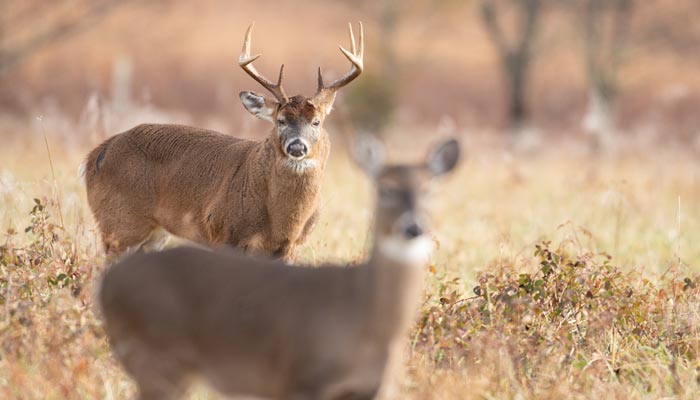
One of the most common questions among whitetail hunter, and a surprisingly complex one is: How long will a buck stay with a doe during the rut?
The answer isn't straightforward. In fact, there's no single number or timeframe you can count on. Several variables influence this interaction between buck and doe, making each scenario a little different. The key factors include the timing of the doe's estrous cycle, the local buck-to-doe ratio, competition from other bucks, and even environmental conditions like weather and human activity.
Let's break it down.
The biggest determining factor in how long a buck tends a doe is where she is in her estrous cycle. A doe is only receptive to breeding for a very short windowusually around 24 to 36 hours. However, a buck can sense hormonal changes that indicate she's approaching estrus several hours beforehand. Using his advanced sense of smell, he'll often detect these signals through scent left in her urine or along her trail.
If a buck finds a doe about 12 hours before she's ready to breed, he may begin shadowing her immediately. He'll follow her movements closely, keeping other bucks at bay while waiting for the right moment. Once she enters full estrus, mating occursoften multiple times over the course of several hours. Even after breeding concludes, bucks may hang around for a while longer, hoping for another opportunity.
In total, it's not uncommon for a buck to stay with a single doe for 36 to 48 hours, depending on circumstances.
The sex ratio in a deer population significantly impacts how long a buck will stick with a single doe. In areas where does vastly outnumber mature bucks, there are more breeding opportunities available. A buck in this type of setting may quickly abandon a doe who isn't quite ready to breed, knowing he can likely find another in estrus without wasting time.
On the flip side, in well-managed herds with balanced ratios, bucks may stay with a near-estrous doe for longer. They simply don't have as many breeding options, and competition from other bucks increases the pressure to secure mating rights when a receptive doe is found.
In areas with a high density of mature bucks, the urgency is even greater. A dominant buck must guard his chosen doe from younger, subordinate bucks looking for an opportunity to swoop in during a moment of distraction.
When a buck tends a doe for an extended period, hunters refer to this as the lockdown phase. During this time, the buck and doe may isolate themselves in thick cover, brushy edges, or remote bedding areas. The buck works hard to keep the doe from running off or drawing attention from rival bucks. This isolation can make both deer nearly invisible during what should be peak rut activity.
Many hunters mistakenly believe deer movement has stopped during lockdown, but in reality, the deer are simply hiding in secluded pockets. Bucks are hyper-focused during this periodconstantly circling downwind, keeping a close eye on the doe, and occasionally stopping to breed.
This behavior can last anywhere from 24 to 72 hours, though the typical tending phase is closer to two days. The more intense the competition in the area, the more likely it is that bucks will shorten this window and move quickly between does.
A variety of other influences can impact how long a buck stays with a doe. These include:
Understanding buck tending behavior is key to predicting rut activity. If deer sightings suddenly drop during peak rut, it may not mean the rut is overit could mean bucks are actively tending does nearby, just out of sight.
Hunters can increase their odds by:
Patterning this behavior takes time and observation, but once you understand the cycle and tendencies of bucks during the rut, you'll be better prepared to intercept them.
So, how long will a buck tend a doe? The most honest answer is: it depends.
It depends on when he found her, how many other does are in heat, how much competition he's facing, and whether external factors are influencing their behavior. Most bucks will tend a doe anywhere from 24 to 48 hours, though the exact timeframe is influenced by a variety of complex biological and environmental variables.
For deer hunters, the key takeaway is that this phase of the rut can be one of the most productiveif you know where to look and are willing to hunt smart and stay patient.
We're deer hunters, just like you. Trust Sportsman's Guide for all your Deer Hunting Gear, including Tree Stands, Hunting Blinds, Hunting Boots and more.