DIY Meat Processing Shop: Tools of the Trade
The best tools for processing meat at home.
May 02, 2023



BIG SAVINGS
+EVERYTHING SHIPS FREE
Learn More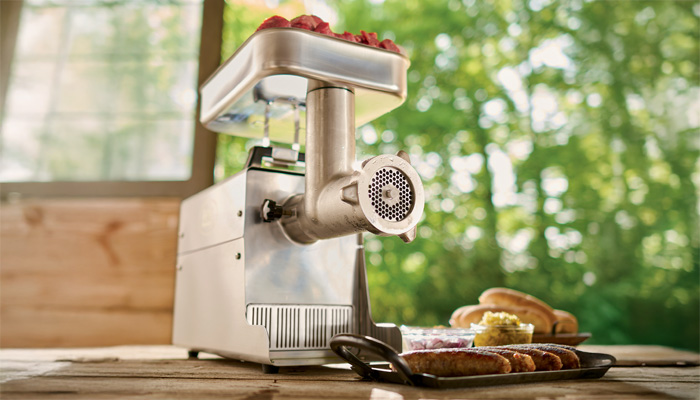
Tonight, disconnect from your Facebook account and invite your real friends over for a truly wild game plan.
Yes, it reads like a fortune cookie, but it's advice well worth considering. If you're someone who likes learning new skills, and prefers socializing in-person rather than over the blogosphere, then maybe it's time to try something new.
This season, gather your deer camp compadres and build yourselves a DIY shop for processing your own wild game. The advantages are many, from filling your mind (and freezer) with the satisfaction of learning new skills, to saving a few bucks. Plus, you'll know with certainty that the deer you've processed is yours, and not someone else's.
Setting up shop in your garage will give you and your buddies a place to split up the work, and swap hunting stories. And if you split the costs of a few helpful processing tools, you'll easily recoup your expenses after a season or two.
This resource is for those relatively new to the wild meat processing game. The tools covered are used after you've already properly field dressed and skinned your deer.
A Meat Cutting Saw is useful for cutting large chunks of meat into smaller, more manageable sizes. If you choose to process the deer meat with the bone left in, then this is the tool to use since it cuts through meat and bone.
Using a knife to cut meat will only get you so far. For starters, it's difficult to cut through bone. Cutting through meat that's been hung in colder temps. is even more difficult. And if you're processing more than one deer, your hands will tire.
Using a Meat Cutting Saw makes efficient work of large cutting jobs not possible with a hand knife. Use it for cutting steaks, chops and cubes, and cutting through bone and frozen meat like butter.
If you're processing an average-sized carcass, a manual meat saw works just fine. If you're processing a few deer with your buddies, an electric saw will be a HUGE time saver.
Don't use a handy man's hack or band saw, unless you want mangled meat and a lot of frustration. A hand saw specific for meat has larger gaps between its teeth. A hack saw has smaller spacing, which will clog quicker with sinew buildup. Plus, you'll get uneven slices that'll cook unevenly.
Chops meat into a smaller, consistent form for making burgers, summer sausage, breakfast patties, brats, meatballs, and more. It functions best when the meat is trimmed of all its sinew and cubed, or sliced into 1-2 cuts. Some grinders come with stuffing tubes, but if you're stuffing a ton of sausage, you're better off buying a separate sausage stuffer.
This comes down to preference, price and how much you're processing. If you're processing just one deer or want an entry-level introductory into game meat processing, you might opt for a manual grinder. But an electric grinder will pay you dividends in time if you plan on processing game each season, or are processing a few deer at a time.
Here's a quick example:
Manual-operated Guide Gear Grinder -- 5 lbs. per minute
Electric Guide Gear Grinder -- 9.6 lbs. per minute
As you can see, the labor time is cut nearly in half!
Refers to the diameter of the grinding outlet (which is also the grinding plate size). The larger the number, the larger the grinding plate, and the greater output per minute. For example, a #22 Electric Meat Grinder will grind less per minute than a #32 Grinder. The most common sizes for home processing falls between a #5 up to #32. For grinding game meat, we suggest using at least a #12 Grinder, but a larger size is recommended for producing larger batches of meat.
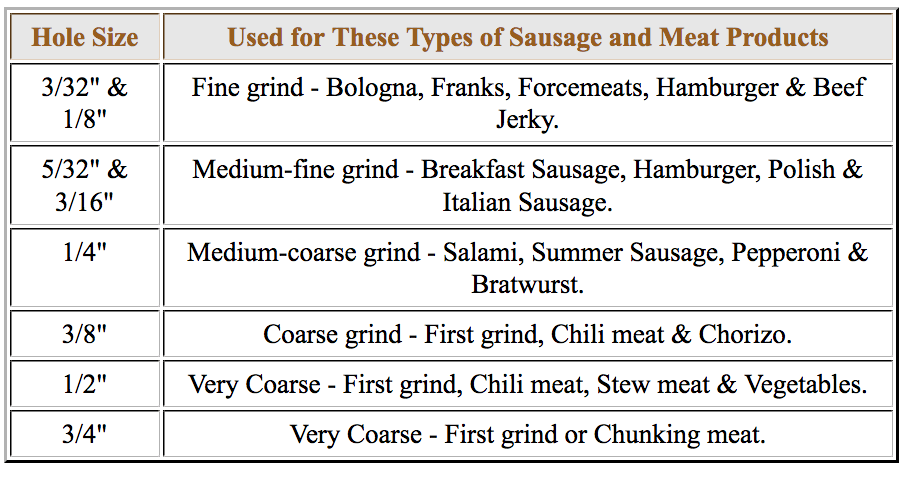
The following chart shows the industry standards for grinder sizes and outlet/plate diameters. Products may vary from manufacturer to manufacturer, so use as a reference only:

Different grinder plates have various hole diameters that result in fine, medium, or course ground meat. Our Guide Gear grinders include plates with smaller 3/16 diameter holes for fine grinding and 3/8 diameter holes for course grinding.
A quick visual guide:
Meat mixers don't grind, chop, or alter the meat in any way. They simply help you blend in spices, ingredients, and fattier-content meat. The mixing paddles ensure an evenly blended end product than you'll get with mixing by hand. The better the ingredients are blended, the better the taste.
Sure, you could use a large stainless steel bowl for mixing ingredients, but you'll have to knead the meat by hand. Since the meat has to be ice-cold to prevent bacteria buildup, working with frozen digits will get old quick.
As a general rule, you can hand mix ground meat for up to 10 minutes before it starts warming to room temp., which is in the danger zone for bacteria buildup. When 10 minutes are up, the meat has to chill in the freezer again for about another hour. You can see how much of a time sucker that process is.
A meat mixer is recommended for time efficiency, especially when mixing more than 15 lbs. of meat at a time. For even greater efficiency, attach an Electric Grinder to the mixer and let the Grinder's motor do the work for you!
Ideal for stuffing seasoned ground meat into sausage casings. Yes, you could use the stuffing tubes that come with your meat grinder, but if you're working on large batches, or want to explore endless sausage/casings recipes, then a stuffer is easier to control. Stuffers are ideal for making sausages, bratwursts, game sticks and more.
You have tons of options for choosing casing types, casing sizes, and ingredients galore, but that's a topic for another day. Whatever your choice of ingredients, fill the cylinder with meat, attach a casing to the tube on the outside, turn the crank, and the meat mixture feeds into the casing. Using a stuffer is more efficient as a 2-person operation; one person will hold the casing to the output nozzle while the other turns the crank.
Tenderizes tough meat cuts so they're easier to chew in steak form, or easier to break apart when made into jerky. The stainless steel combs pierce the meat and work their magic by breaking down muscle fibers, which makes for more tenderized meats. Our Guide Gear 2-in-1 model not only tenderizes, but also slices each cut into the perfect thickness for making jerky. This unit slices jerky up to approx. 2/16th of an inch.
As you start experimenting with food processing tools and techniques, you'll soon get a feel for what works for you. And you'll further appreciate the many benefits of processing your own fresh game meat vs. purchasing preservative-packed processed meats.
Shop Sportsman's Guide's large selection of Meat Processing products