Bowhunting The Middle Ground
Where to place your tree stand for better chances of deer-hunting success during bow season.
April 27, 2023



BIG SAVINGS
+EVERYTHING SHIPS FREE
Learn More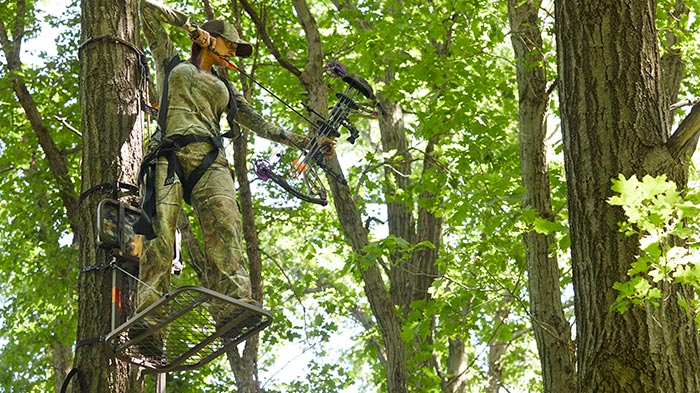
Most of the year, a mature whitetail buck is one of the most solitary and survival orientated animals imaginable.
Generally speaking, his lifestyle is one of separation. Only as the need to breed begins to rule his life will he spend much time interacting with the deer herd in general. It is during this short period of time that he commits the main error (drastically increased daytime movement) that puts him within our reach.
Since most of this movement focuses around scent checking numerous doe groups in their bedding areas, it goes without saying that bucks must cover some ground in order to accomplish this. It is this route between doe core areas that I refer to as the middle ground. It is here that I lie patiently in wait.
The best approach to locating these pass through areas revolve around extensive post-hunt scouting. Immediately after I finish hunting each fall, I invest large amounts of time in walking-out every possible nook and cranny of my hunting acreage(s). Take topographic maps and/or aerial photo's along and mark them with the location of all information gained. Where are the rubs and scrapes? Are they random or concentrated? How do they relate to the surrounding cover and lay of the land? Where do the doe groups' bed and feed, and what are their travel routes between the two? Where are topographic and/or vegetative features (man-made or natural) that funnel deer movement? And finally, how does all this information jive with my understanding of big buck rutting movement?
There also are countless other bits of information that I collect and process, because at this point it is vital to strive for a complete view of the entire picture of the lifestyle of the local deer herd rather than focusing on only parts of the puzzle. I take the information gained from these scouting forays and combine it with past hunting experience of the location (keep a journal) to formulate a connect-the-dot puzzle of the area. However, this is not a perfect science, just do the best you can in establishing an overall picture.
Many hunters find a concentration of scrapes and/or rubs and base their entire hunting strategy on their new found honey hole. After all, haven't we been forever taught the importance of hunting over buck sign? It is here that most hunters are short-changing themselves. Consider this: areas of concentrated sign are usually located in close proximity to nighttime feeding/daytime bedding areas, and trying to hunt these spots will soon result in educated and/or relocated deer.
It always has been my policy to hunt as low impact as possible. I leave the deer alone in their high-interaction areas, allowing them to function on a normal routine. A mature rutting buck will never stay in one place for long (unless he is with a receptive doe in a breeding hideout) thus, my entire approach to bowhunting the middle ground revolves around ambushing mature bucks somewhere in the middle of their travels between doe groups.
A couple of years ago, I was perched in a big maple tree, in a time-proven big buck travel corridor in Illinois. I'd hunted this spot twice in the last 10 days, with zero sightings of big bucks. The rut was peaking now however, and I knew from past history that it should only be a matter of time until some big bone would show up.
In keeping with the nature of hunting the middle ground, time passed, deer didn't. Since I was in a fairly isolated location, I didn't drop my guard as mid-day approached. At 11:45 a.m., I couldn't stand it any longer, and out came the peanut butter and jelly sandwich from my daypack. I'd taken no more than three bites when I spied a big set of antlers gliding through the timber toward me. There was no question about this one being a keeper. Clearly headed somewhere in a hurry, the big fellow was a sight to see.
When the moment was right, I slowly came to full-draw; watching glassy eyed as the whopper strode up to 15 yards broadside. In seconds it was over; the sound of my heart beating in my ears the only thing left to bring me back to reality. I'd done my part. Short minutes later, I stood over a bruiser of a 7 x 5 buck. He would was later stretch a tape to 170 inches.
It has been my experience when hunting the middle ground that one of every three big buck encounters will occur between 10:30 a.m. and 2:30 p.m.; thus I plan on staying on stand all day. To do so, comfort is a necessity. API treestands are a proven winner in this department. I dress light for my walk into my stand, and carry a Badlands 2200 Series daypack with extra clothes (Scent-Lok, sock-hat, rain gear, etc.), food and drink, camera, mini mag-light, notepad, limb saw, toilet paper, pee bottle and rattling antlers/grunt call.
Also when the moment of truth arrives, don't let yourself be the weakest link in your gear.
Shop Sportsman's Guide for everything Deer Hunting