Best Turkey Decoy Setups for Hunting Season | Proven Strategies
Discover the best turkey decoy setups for the most common hunting scenarios. Learn when to use hen, jake, and full-strut decoys to bring gobblers in close this season.
April 22, 2026



BIG SAVINGS
+EVERYTHING SHIPS FREE
Learn More
The interesting part about turkey hunting is that strategies can be subjective. What works every time for one hunter may not work even one time for someone else. Most hunters have a tried-and-true method or a unique spin on setup that they swear is the secret to punching their tag. And that's what makes turkey hunting a trial-and-error sportand so much fun! If you're just starting out, there will be plenty of learning opportunities for you to figure out your preferences and strategy, but in the meantime, we recommend starting with proven setupsespecially when it comes to placing turkey decoys.
We'll share four of the most common decoy setups that bring turkeys in close and key information on when to use each setup. We'll even tell you the number one mistake that hunters often make with decoys (hint: don't stick to one setup all season long!).
Turkey decoys turn a curious tom into a committed one. When they hear your turkey call, they are actively searching for the bird that's making the noise. Your decoy gives them a visual that keeps them moving towards you.
Different decoys tap into different behaviors and trigger different reactions. For example, hen decoys spark curiosity and make toms feel comfortable. Jakes incite jealousy and provoke a tom to establish dominance. And full-strut tom decoys bring out an aggressive, territorial instinct which pulls dominant toms in to confront the competition.
Furthermore, a well-positioned decoy setup can bring in a tom exactly where you want him, so you have better shooting alignment. Most importantly, a realistic decoy draws a tom's attention away from you, giving you time to set up the perfect shot.
Best used for: Early season, low-pressure birds, or cautious gobblers
What you need: A breeding hen or a feeding hen (like this feeding hen decoy from Avian)
How to set up: Find a low-pressure area and position the hen 15 to 20 yards away from your blind or position. Face the hen slightly quartering away from you.
Why it works: At the beginning of the season, toms are hyper-focused on breeding. When they spot a lone hen, the tom sees an opportunity for breeding without hassle or confrontation. A minimal turkey decoy spread feels organic and non-threatening to a tom.
A Love Triangle Variation
Best used for: Mid-season gobblers that are responding, but hesitating or hanging up out of range
What you need: A hen and a jake decoy (here's a jake + hen combo that works great!)
How to set up: Position the hen 15 to 20 yards away from your blind or position. Then angle the jake facing towards you about 5 paces from the hen.
Why it works: The spacing variation creates a more natural, less aggressive scene than a tight pairing in a typical hen and jake combo or breeding pair setup. In the gobbler's eyes, he sees a nearby hen and a young bird in the area, but not yet actively breeding. It introduces a touch of competition to get the tom moving, but doesn't intimidate him and scare him away either.
Best Used For: Mobile hunters who want to cover ground
What you need: A lightweight, collapsible hen and jake (try the Purr-fect Pair from Montana Decoy)
How to set up: Position the hen 15 to 20 yards away from you. If you add the jake, keep it close to the hen and position is quartering toward you. Position yourself against cover so it disguises your outline.
Why it works: When a gobbler responds but isn't fully committed, a simple hen-and-jake setup gives him just enough visual confirmation to keep coming. The hen signals opportunity, while the jake introduces a subtle challengeoften triggering a dominant bird to close the distance and assert himself. Because the spread is minimal and set up quickly, it feels natural and avoids overwhelming cautious birds, helping turn a quick encounter into a shot opportunity.
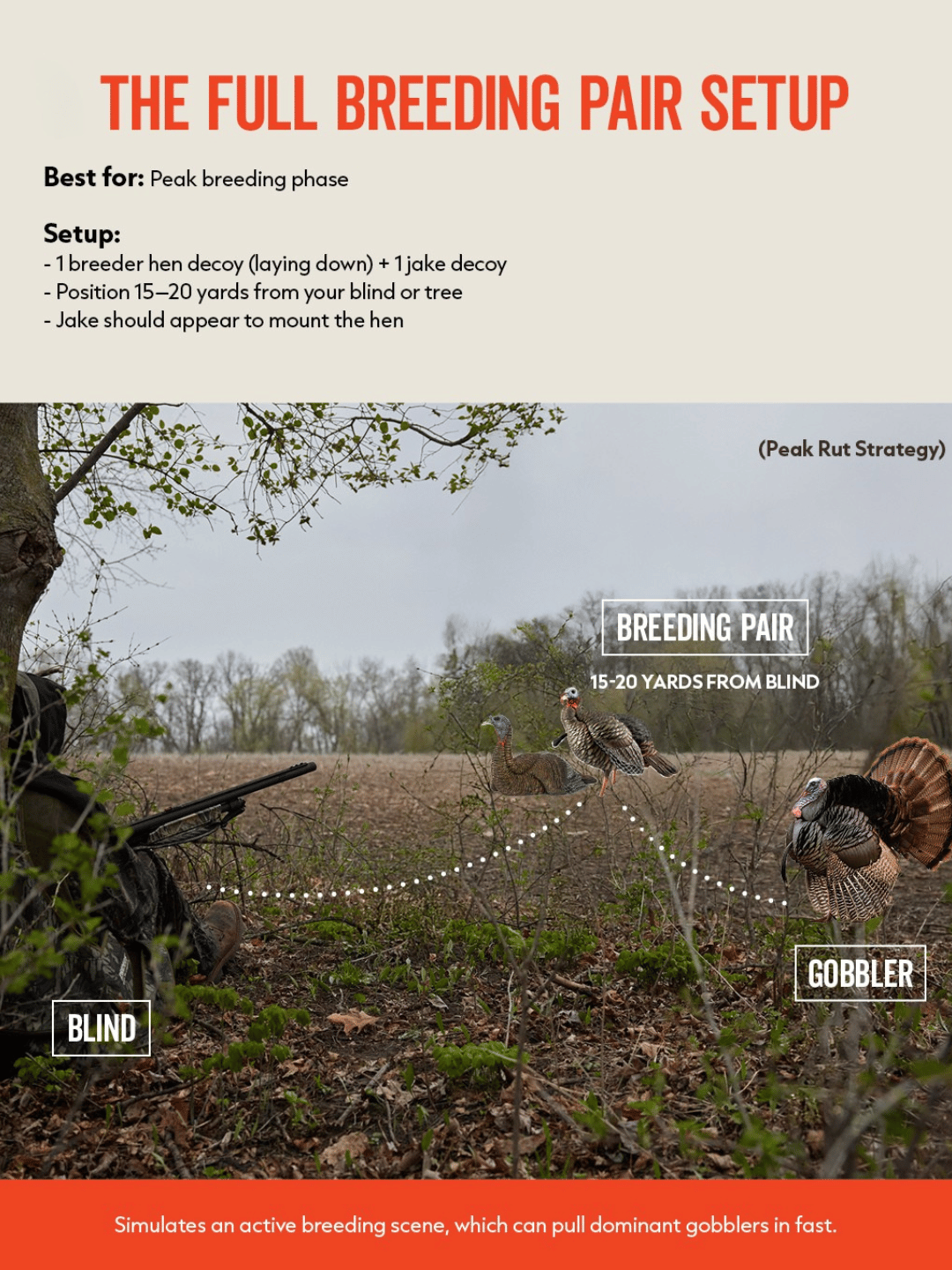
Best used for: Peak breeding phase
What you need: A breeder or laying down hen and a jake decoy
How to set up: Use this setup in areas where visibility is high like an open field or on the edge of the field. Position the hen 15 to 20 yards away from your blind or position. Then position the jake to appear as though he is mounting the hen.
Why it works: You're staging a scenario that screams dominance and breeding opportunity. Few mature toms can ignore another bird actively breeding in their territory.
The spring season changes from day to day, and that means the birds are constantly changing, too. One of the most common mistakes we see is hunters sticking with the same decoy setup from early season to close. At the beginning of the season, gobblers are eager and responsive. As the season progresses, pressure builds and birds get pickier and more skeptical. Changing your setup to match those shifts is what turns encounters into opportunities. It's also the best way to find out what really works for you!
Turkey hunting rarely goes exactly to plan, but the hunters who stay ready to pivot are the ones who find success in the field. The right decoy setup for you comes down to matching the moment you're in, reading the bird, and giving him a reason to commit. Switch it up, stay mobile when needed, and let the situation dictate the setup. Do that and you're likely to punch your tag this season.