Best States for Whitetail Deer Hunting
See the best states for whitetail deer hunting, ranked by opportunity, trophy potential & access. Learn where to hunt & shop gear at Sportsman's Guide today!
August 24, 2026



BIG SAVINGS
+EVERYTHING SHIPS FREE
Learn More
Ask ten hunters where to chase whitetails and you'll get ten different answers, usually built around one giant buck somebody saw on a hunting show. This guide takes a different approach. It ranks the best states for whitetail deer hunting by real opportunity in the field based on real metrics, the kind you can actually plan a season around.
Opportunity is a blend of things: trophy potential, how many deer are on the ground, how much public land you can hunt without knowing a landowner, and how realistic your odds are as a traveling hunter. A state can grow giant bucks and still be tough to draw a tag in. Another can be loaded with deer but short on mature bucks. The states that rise to the top balance all of it.
This one is written for the hunter doing the work themselves. DIY hunters, traveling hunters, and whitetail diehards planning next season will find state rankings, trophy breakdowns, public-land picks, and focused spotlights on destinations like Texas and Illinois. You'll also find trip-planning steps, gear notes, and answers to the questions hunters actually ask. And when it's time to gear up, Sportsman's Guide has you covered from trail cameras to tree stands.
Rankings only mean something if you know what's behind them. Here's the criteria used to sort the top whitetail hunting states, weighted toward what matters to a hunter planning a trip rather than a statistician counting entries.
- Trophy potential and age structure: How consistently a state produces mature bucks, drawing on Boone and Crockett Club and Pope and Young Club record data.
- Deer density: How many whitetails are on the ground, which shapes how much action you'll see day to day.
- Public land and access: Total public acreage plus walk-in and access programs that open private ground to hunters.
- Tag availability and cost: Whether nonresident tags are over the counter or draw-only, and what they cost.
- Hunter pressure and season structure: How crowded it gets and whether archery or muzzleloader seasons give you an edge.
Groups like the Boone and Crockett Club and the National Deer Association publish the harvest and record data that make this kind of comparison possible. Their numbers form the backbone of any honest look at the states with the best trophy whitetail deer, and they help separate states riding a single lucky buck from those that produce year after year.
One caveat worth stating outright. Exact rankings shift season to season as herds, weather, and regulations change, and the nonresident experience often looks nothing like the resident one because of tag draws and lease costs. The broad tiers, though, stay remarkably steady. The Midwest keeps producing giants, the big-woods states keep offering room to roam, and that consistency is what you can plan around. For a deeper look at what to bring once you've picked a state, see our whitetail hunting checklist.
Here are the 10 best states for whitetail deer hunting when you weigh trophy potential, deer numbers, public access, and how friendly each is to a DIY trip. This is an opportunity ranking, so a state loaded with deer and public land can outrank a pure trophy factory that's nearly impossible to draw.
The Midwest dominates the top of the list for good reason: rich farm country, strong age structure, and archery-heavy cultures let bucks grow old. But don't sleep on the states lower down. Nebraska and the Southern standouts deliver elbow room and accessible tags that make them some of the best places to hunt whitetail deer if you're just getting into travel hunting.
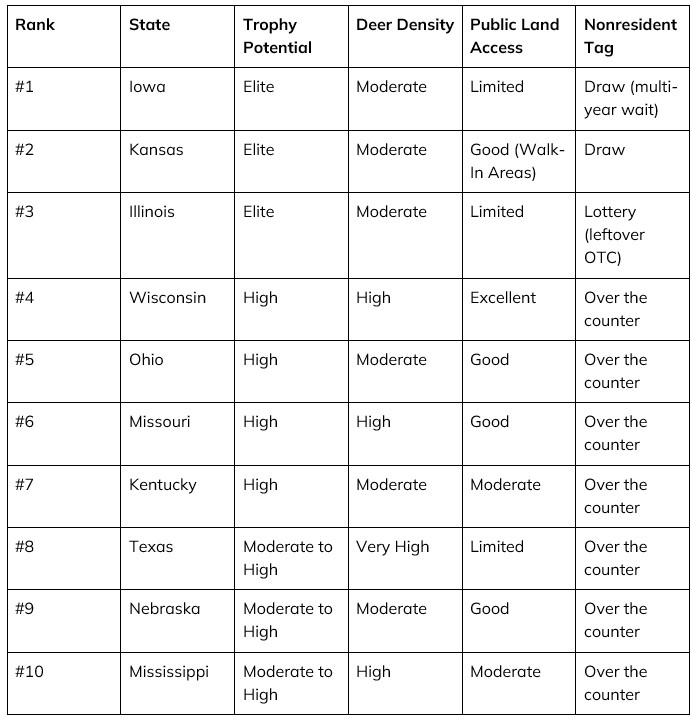
Tags and quotas change every year, so always confirm the current rules with the state wildlife agency before you commit to a trip. Treat this as a starting map, not gospel.
If your goal is antler, not just action, a tighter group of states rises to the top. The states with best trophy whitetail deer are concentrated in the Midwest, where a specific recipe repeats itself: nutrient-rich agriculture, controlled hunting pressure, and tag systems that let bucks reach four, five, and six years old. Iowa, Illinois, Wisconsin, Kansas, Ohio, Kentucky, and Missouri consistently anchor this list.
The proof is in the record books. The Boone and Crockett Club's data leans heavily on this region, and the famous Missouri Monarch, a non-typical found in 1981, is the current world record non-typical whitetail, and still unbroken. Iowa and Illinois routinely produce more record-book entries per year than states many times their size, and that's not luck. It's low gun pressure, archery-driven cultures, and strict tag limits working together.
The catch for traveling hunters is access. Many of these trophy states are draw-only for nonresidents, and Iowa in particular can take several years of applying before you pull a tag. Where over-the-counter options exist, quality private ground often runs through leases or outfitters that carry real cost. That's the trade-off: peak trophy potential usually means less flexibility and a bigger budget. If you want a more balanced experience, lean back on the opportunity ranking above, where deer numbers and access soften the odds.
If you'd rather see deer every sit than hold out for one giant, look at the states with the highest whitetail deer population. Texas leads the country by a wide margin, with an estimated herd close to five million, and Michigan, Wisconsin, Pennsylvania, and several Southeastern states each hold populations that climb into the seven figures. These are the places where a week in the woods almost guarantees action.
More deer doesn't automatically mean more big bucks, and that's an important distinction. High-population states give you frequent encounters, which is exactly what a new or young hunter needs to build confidence and learn to read animals in real time. The trade is that heavy numbers sometimes come with younger age structure or more hunting pressure, so mature bucks can be harder to isolate even when deer are everywhere.
Population comes down to habitat, winter severity, and predators. Mild Southern winters and diverse Texas terrain support enormous herds, while harsh Northern winters and wolf pressure hold numbers in check in parts of the Upper Midwest. Agencies and the National Deer Association track these trends through annual harvest data, which is the best way to see where herds are climbing or slipping before you book a trip.
For a first-time or youth hunt where seeing deer matters most, a high-population state is almost always the smarter call.
For DIY hunters without a lease or family land, public access is everything. The states with most public land for whitetail hunting combine big federal and state holdings with programs that unlock private ground, and a handful stand out for the sheer room they offer a mobile hunter.
- Michigan: Millions of acres of state and national forest, especially across the northern Lower Peninsula and the U.P.
- Wisconsin: Extensive county, state, and national forest land with a strong public-hunting tradition and over-the-counter tags.
- Minnesota: Vast big-woods public land in the north plus productive Wildlife Management Areas farther south.
- Missouri: A deep network of Conservation Areas and public hunting ground that's open and well-documented.
- Kansas: Big-buck genetics paired with the Walk-In Hunting Access program that adds huge acreage of enrolled private land.
- Nebraska: An underrated blend of public land, walk-in access, and low pressure that gives you space to roam.
Maine and Pennsylvania deserve mention too, both offering big public systems for hunters willing to cover ground. The move for mobile hunters is to research Wildlife Management Areas and walk-in maps online before the trip, mark several backups, and stay ready to relocate when you hit pressure. Public land absolutely produces mature bucks. It rewards the hunter who scouts hard, hunts the overlooked pockets, and stays mobile with a lightweight setup.
Four states, four completely different ways to hunt whitetails. These spotlights cover the range from private-land Texas to trophy-country Illinois to the DIY-friendly powerhouses of Ohio and Wisconsin, so you can match a destination to your style and budget.
Texas is the deer-numbers king, and the experience is built around private land. Most hunting happens on leases or with outfitters across wildly varied terrain, from the thick South Texas brush country to the rolling Hill Country. Tags are accessible over the counter, and the season is long, but budget for access since quality public ground is limited. Texas is ideal for hunters who want high deer activity, a social lease-camp atmosphere, and a good shot at a solid buck without a hard-to-draw tag. Pack for heat early in the season and brush that eats gear. A good set of hunting clothing built for warm weather goes a long way here.
Illinois is trophy country, full stop. Western Illinois river-bottom counties are legendary for producing giant bucks, and the state's archery season is a bowhunter's dream. There's a lottery in place, but nonresidents can get leftover over-the-counter archery tags, though firearm permits run through a draw, and much of the best ground is leased or outfitted.
This is a destination for the hunter chasing a genuine wall-hanger who's willing to invest in access. Time your trip around the November rut for the best odds, and come prepared for cold, wet Midwest weather that can turn on you fast.
Ohio might be the best all-around DIY trophy state in the country. It offers over-the-counter tags for nonresidents, a strong public-land system, and a real chance at a mature buck without a lease. The rut runs strong in early to mid-November, and eastern Ohio's hill country holds deer in terrain that spreads hunters out.
For a traveling hunter who wants trophy potential and accessible tags in the same trip, Ohio is hard to beat.
Wisconsin pairs high deer numbers with enormous public land and easy tag access, which is a rare combination. You get frequent encounters, room to hunt, and legitimate shots at mature bucks, especially in the western farmland and the big northern forests. It's one of the most beginner-friendly trophy-capable states out there. Winters get serious, so late-season hunts demand real cold-weather gear, but the payoff is a state where a DIY hunter can build a repeatable game plan year after year.
Wherever you land, dial in your setup before you go. Browse the full hunting department or search directly for whitetail deer hunting gear to build your kit.
A great whitetail trip is mostly won before you leave the driveway. Here's a simple process for planning whitetail deer hunting trips across any region, whether you're eyeing the Midwest, South, Great Plains, or Northeast.
The guided-versus-DIY question comes down to budget and experience. A fully outfitted hunt shortens the learning curve and boosts success odds but costs the most. Semi-guided splits the difference. A fully DIY public-land hunt is the cheapest and most rewarding once you've got the skills, but it asks the most of you.
A great starter trip might be a public-land bow hunt in Nebraska or an Ohio rut hunt on over-the-counter tags. Think long term, too. The hunters who consistently punch tags usually know two or three states deeply rather than chasing a new one every fall. Build a rotation, learn the ground, and your odds climb every season.
Picking the right state is only half the battle. Understanding where whitetail deer are found and how they move helps you pick the right ground within that state. Whitetails range across nearly the entire United States and into southern Canada, thriving anywhere that mixes food, cover, and water. That adaptability is why they're the most widespread big-game animal on the continent.
Habitat preferences shift by region but follow a pattern. In the Midwest, deer key on agricultural edges where crops meet timber. In the big-woods states, they work clear-cuts, oak ridges, and swamp edges. Across the South, hardwood bottoms and pine transitions hold deer.
Everywhere, the money is in the transitions: the bedding areas, the feeding zones, and the travel corridors that connect them. Learn to spot those on aerial and topographic maps and you can pattern deer on ground you've never walked.
Movement changes with the calendar. Early season, deer run predictable bed-to-feed patterns you can hunt on the fringes. During the November rut, bucks abandon those routines and cruise doe bedding areas and pinch points, which is when a hub-of-activity setup pays off. Late season swings back to food as deer rebuild energy in the cold.
On a Wisconsin farm, that might mean sitting in a standing cornfield in December; on an Ohio ridge, it might mean a white-oak flat in October. Read the movement, and the right stand location reveals itself. A well-placed ground blind or tree stand lets you hunt those spots without getting picked off.
Where are the biggest whitetail deer in the world? The honest answer points to the agricultural heart of the Midwest and parts of Canada, where genetics, age, and nutrition line up better than anywhere else. Southern Iowa, western Illinois, eastern Kansas, and the river-bottom country of Kentucky and Missouri produce record-class bucks with startling regularity, and Canadian provinces like Saskatchewan and Alberta add giant-bodied deer with heavy racks.
The Boone and Crockett Club tracks these record-class typical and non-typical bucks, and the geographic clustering in their records is no accident. Nutrient-dense crops give bucks the raw material to grow big antlers, mild-to-moderate winters in the core Midwest reduce stress, and low relative hunting pressure lets bucks survive to the older age classes where antlers peak. Age is the ingredient most hunters underestimate. A buck simply cannot reach his potential if he's harvested at two or three years old.
For trip planning, treat the record book as inspiration, not a promise. The same regions that top the trophy rankings are where your realistic shot at a giant is highest, but even there, most hunters go years between true monsters. Balance the dream against your budget and the access reality, and you'll enjoy the hunt a lot more than if you stake everything on a world-record buck.
Traveling for whitetails means packing gear that performs from Texas brush to Wisconsin timber. The goal isn't more equipment, it's a versatile kit that works across states and conditions. Here's the core of what a traveling whitetail hunter should carry.
- Weapon and ammo or arrows: Sighted-in and matched to your method, with extras.
- Optics: A quality binocular for reading deer in cover, plus a rangefinder for ethical shots. Shop optics, scopes, and sights.
- Layered clothing and boots: Merino base layers, an insulating mid-layer, and a quiet, weatherproof outer shell, plus scent-free waterproof boots.
- A mobile stand or blind: Lightweight setups let you relocate on pressured public land.
- Trail cameras: For scouting movement before and during the hunt.
- Scouting tech: Mapping apps for e-scouting bedding, food, and access.
- The paperwork: Tags, license, and a printed copy of state-specific regulations.
Trail cameras earn their keep on a travel hunt by telling you where deer are moving before you burn a sit. The Muddy Pro Cam 20MP Trail Cameras, 4 Pack is a strong value for covering multiple spots at once, and the Tactacam Reveal X 3.0 Cellular Trail Camera sends images straight to your phone so you can scout without disturbing the area. Browse the full trail cameras and accessories selection to match your setup.
For your stand setup, a portable option keeps you mobile. The Guide Gear 18' Archer's Ladder Tree Stand is a comfortable, budget-friendly pick for a semi-permanent spot, while the Guide Gear Hang On Tree Stand paired with Guide Gear 20' Rapid Climbing Sticks gives you a run-and-gun kit for public land. Dial in the rest of your list with our whitetail hunting checklist.
For a first-timer, prioritize deer numbers and easy access over pure trophy potential. Wisconsin, Michigan, Pennsylvania, and Missouri all combine high populations, accessible tags, and solid public land, so you'll see deer and get reps. Frequent encounters build skills and confidence faster than holding out for a giant in a low-density trophy state.
Wisconsin, Ohio, Nebraska, and several Southern states offer relatively accessible nonresident opportunities, often over the counter. Even top trophy states like Illinois sell over-the-counter archery tags. Regulations and quotas change often, though, so always confirm the current rules with the state wildlife agency before you plan around a tag.
Nebraska, Missouri, Oklahoma, and parts of the broader Midwest offer the best mix of affordable tags, large public land systems, and low-cost camping or lodging. Remember that tag price is only one line in the budget. Fuel, travel time, and access all factor in, and a cheap tag in a far-off state can cost more overall than a closer option.
Yes. Public land produces mature bucks every season for hunters willing to scout hard and hunt the pressured-off pockets others skip. Mobility, timing the rut, and understanding food-to-bedding transitions usually matter more than whether the dirt is public or private. A well-scouted public hunt often beats a poorly planned private one.
Texas holds the largest whitetail population in the country by a wide margin, with a herd estimated well over five million. Michigan, Wisconsin, and Pennsylvania also carry populations into the millions, making all of them strong choices when your priority is seeing deer.
The largest whitetails consistently come from the agricultural Midwest, especially southern Iowa, western Illinois, and eastern Kansas, along with Canadian provinces like Saskatchewan and Alberta. Rich crops, older age structure, and lighter pressure combine to grow record-class bucks in these regions.
The best state to hunt whitetail deer isn't the same for everyone. It's the one that fits your goals, your budget, and your style. If you want a wall-hanger and can play the draw game, Iowa, Kansas, and Illinois are worth the wait. If you want action and accessible tags, Wisconsin, Ohio, and Texas deliver. If you're chasing a DIY public-land adventure, Missouri, Nebraska, and Michigan give you room to roam. Rankings, trophy data, and access programs all point the way, but your priorities make the final call.
Here's the real secret: success comes from learning a few states deeply, not from chasing a new one every fall. Pick your spot, put in the scouting, build a rotation you trust, and watch your odds climb season after season.
When you're ready to plan the next trip, start with the right gear. Explore deer hunting gear and accessories at Sportsman's Guide and dig into more whitetail content on The Guide blog. Then go make it happen.