Try the Flick Shake Technique for Bass
Master the "flick shake" technique to bring the bass in.
John N. Felsher
June 08, 2023



BIG SAVINGS
+EVERYTHING SHIPS FREE
Learn More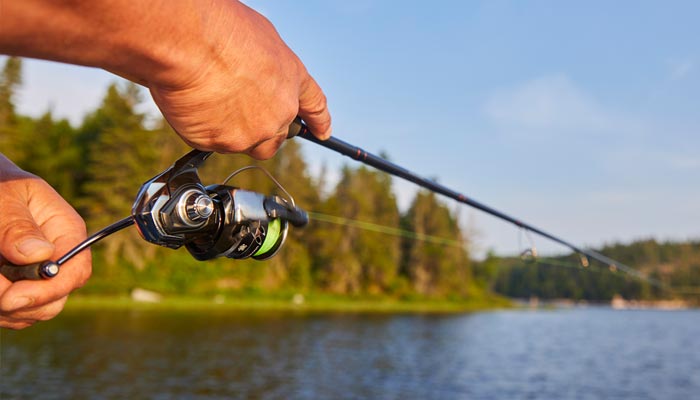
To quote Jerry Lee Lewis, "There's a whole lotta shakin' goin' on." But when it comes to bass fishing, there's a new killer in town!
"A flick shake is a hot new finesse technique," said Mike Iaconelli, a Bassmaster Classic champion from Runnemede, N.J. "It consists of a wide-gap hook with a weight attached to the hook shank instead of the eye. It's designed for fishing wacky style with the hook through the center of a straight worm. Tru-Tungsten makes a jighead called a Flea Flicker specifically designed for fishing this technique."
With the weight slightly toward the back of the shank, it creates a pivot point. As the rig falls, the worm ends shake and vibrate, giving irresistible action. Also called a wacky shaky head or a wacky jighead rig, it gives similar action to a wacky worm, but goes deeper much faster.
"When fish go deeper than 10 feet, it takes a conventional wacky worm too long to get to the strike zone," Iaconelli explained. "The flick shake shows fish traditional wacky action, but at much deeper levels. The weight sinks faster than the worm, so it drives it down with the bait waving and twitching above it. Bites normally occur on the fall so always let it fall on a semi-slack line, not tight or too slack. Control the line and watch it as it falls."
Anglers can use various styles and sizes of straight-tailed worms with a flick shake rig. In deeper water use larger, thicker worms. Although generally a deeper presentation, anglers can also use small finesse worms in shallow water.

"Where this technique really excels is in a deep situation with really clear water," said Terry Scroggins, a professional angler from Palatka, Fla. "I like to use it in clear water about 15- to 20 feet deep. In clear, deeper water, I go with a big Yum Dinger-style worm. In shallower or more stained water, I go to a Houdini-style finesse worm. A Yum Dinger actually has more action on the initial fall. The worm ends helicopter down, but it doesn't have much action on the bottom. In stained, shallow water, the bait hits bottom quickly, so I like a bait I can shake to give it more action."
Most people fish a flick shake vertically. Drop it next to bridge pilings, standing timber, along a bulkhead or next to a deep grass bed. Anglers could also just fish it in deep holes, along ledges or over humps. If a fish doesn't bite on the fall, let the bait sit awhile, twitching it occasionally. Periodically, hop it off the bottom and let it fall back again. Fish it slowly, keeping it in the strike zone as long as possible.
"A flick shake offers great action even when the angler is not doing anything with it," Scroggins explained. "On the bottom, half the worm will stand up and undulate. Pull the bait and the worm folds. Stop it and it opens up again. A flick shake works very well when fishing vertical structure like bulkheads or steep ledges with vertical drops because every time you pick it up, it falls several feet before it hits bottom again."
In shallow water, anglers can use it over beds. Just let it sit on the bed and twitch in the water currents. Hop it across the bottom around cover like logs or weed patches. Let it fall over the drop-off and work it all the way back to the boat.

Although bass sometimes, grab it and run, they typically make more subtle bites. The angler might only feel a slight thump on the line or perhaps not even feel the strike. The line might simply move in a contrary direction, straighten, or just feel mushy like the bait snagged on weeds. Since the bait feels natural, a bass might hold it in its mouth for a while or swallow it. Reel down all the slack. Feel for the fish and set the hook hard.
As a light finesse bait, most anglers prefer to throw this rig on a spinning rod. A 6.5- to 7.5-foot spinning rod makes an excellent choice. People could use baitcasting equipment, but the line rolls off a spinning rod more smoothly, allowing the angler to control the fall with a finger. Also use light line, about 4- to 12-pound-test.
"Line choice is very important," Iaconelli stressed. "For a flick shake, I use Berkley Trilene 100 percent fluorocarbon line. Fluorocarbon line is so dense that it sinks more than monofilament. Monofilament line tends to float, so the fluorocarbon line enhances the fall of the bait."
The technique also works around schooling bass and when bass go deep after schooling. It can also work on other species, such as bream, depending upon the hook and bait size or type.
At Sportsman's Guide, we love to fish. Trust us for all your Fishing Gear, including Fishing Rods, Fishing Reels, Fishing Lures and more.