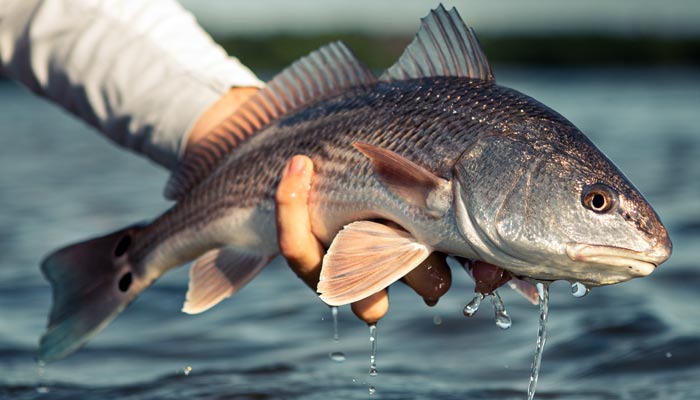
When chasing redfish, most anglers along the Louisiana-Texas border naturally head toward Sabine Lake, but the Sabine River channel north of the lake holds abundant spot-tails as well.
South of Interstate 10 at Vinton, La., the Sabine River spreads out through cypress swamps, brackish and salt marshes. Numerous sloughs, feeder creeks, canals and tiny tributaries flow into the main channels. A 2-year-old drought increased the salinity level in the Sabine River, which forms the border between Louisiana and Texas. In such drought years, salty water may extend well north of I-10.
With the salinity levels so high, I wouldn't worry about fishing the lake so much, said Capt. Ronny Doucett, a fishing guide and co-host of Outdoor X-Tremes television show in Lake Charles, La., with David Rabalais. I generally start fishing for redfish from the I-10 Bridge south. Just south of the interstate, a high powerline crosses the river. The canal by the high-lines usually has fish.
Redfish Go With The Flow
Redfish lurk in the mouths of tributaries waiting for something to flow to them. On a falling tide, these cuts drain swamps and marshes, delivering a smorgasbord of morsels to chomping mouths. Redfish feast on shrimp, crabs, mullets, shad, minnows and anything else they can gulp. In the mouths of these drains, use DOA (brand) shrimp in natural, clear or gold flake versions. On a falling tide, throw one without any extra weight. Toss the shrimp as far into these cuts as possible and let the current pull it naturally. Redfish, plus bass, speckled trout and flounder, hammer it as it enticingly drifts to deeper water.
Casting such a light lure requires finesse and light tackle. Powerful redfish require heavy tackle and brute strength to be subdued. To increase casting ability on heavier line, clip a small split-shot sinker to the line about 12 inches to 24 inches above the shrimp. This makes a modified Carolina-rig that redfish cannot refuse.
Doucett prefers to throw a DOA shrimp on a popping cork, almost like a live shrimp. He works it vigorously to increase action. Rattles in the 3-inch cork telegraph the enticement to prowling redfish.
I put a DOA on a leadhead jig below a popping cork and fish it 6 to 8 inches off the bottom, he said. Pop it vigorously because redfish are attracted to sound. Throw it out, count to five, then pop it much stronger than if you were fishing with a live shrimp. When redfish hit, there's no doubt. They clobber it and start running.
At other times, Doucett throws a DOA shrimp just as he would any other plastic jig. First, however, he modifies it by removing the factory weight and hooks. He then slips the shrimp onto a Gene Larew leadhead with a wide-gap hook.
Anglers fishing the Sabine or any other marsh environment might spot spotted tails or dorsal fins breaking the surface as redfish forage for crabs along shorelines. Along the flats lining the river channel, look for feeding fish pulverizing baitfish, crabs or shrimp. Toss topwaters or spinnerbaits to these hungry predators.
Topwater Excitement
Fishing topwaters for redfish is a real heartbreaker, Doucett said. Nothing in the world hits a topwater like a redfish. Personally, I like throwing a Super Spook because it has more hooks and lays a little flatter in the water than a Top Dog. My favorite is a bass color. It looks like a mullet. I paint the eyes red and put a little red fingernail polish on the belly to give it a bleeding appearance. Red just does something to fish. Top Dogs have vivid red eyes and make a clack that sounds more like a shrimp than any other bait.
In shallow water, spinnerbaits or buzzbaits often tempt redfish. Bass anglers up the Sabine prove this theory in almost every tournament. They frequently land about as many redfish as bass when fishing tournaments on the lower end of the river.
Big spinnerbaits work for redfish, Doucett said. I like 1/2-ounce chartreuse spinnerbaits with large, single, bronze, copper or gold Colorado blades. Use a single blade with a lot of thump. I like to slow-roll it along the bottom. In shallow water, keep the rod tip high and slow-roll it just below the surface.
With salinity so high, fish some traditional bass honeyholes in the lower Sabine River for redfish. Try the rocks at the old Burned Out Bridge, which once carried U.S. 90 into Texas. Wooden pilings still stick out like rows of dead trees. Fish lurk around these pilings and in the canal running parallel to the old highway route.
Also, try the cuts around Phoenix Lake or the Ship Graveyard near Conway Bayou. Several old sunken wooden ships create ideal habitat for redfish to ambush baitfish. Ancient spars and ribs stick out of the river channel like a flooded forest. Redfish may hide inside these boats, waiting to pounce on unsuspecting baitfish or other morsels. Inside the rotting boat hulls, throw topwaters, spinnerbaits or even Texas-rigged bass worms. A redfish may hit anything that also tempts a bass.