Signal Mirrors: An Invaluable Life-Saving Device
Learn how to use a signal mirror and it could mean the difference between life and death.
Tom Watson June 08, 2023



BIG SAVINGS
+EVERYTHING SHIPS FREE
Learn More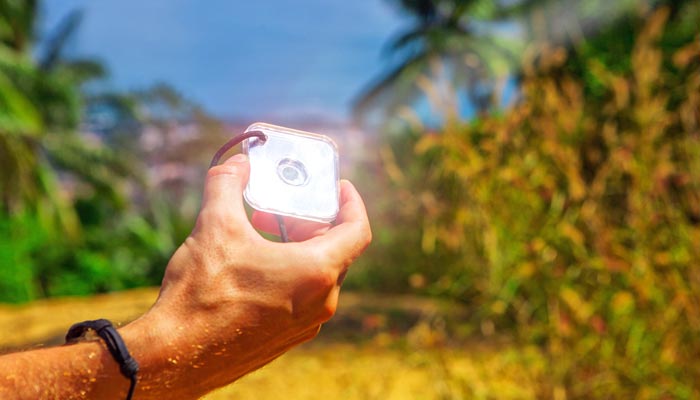
The married couple had been stranded on a remote island in southeast Alaska for over a week. Overhead, a Japanese airliner spotted the repeated pattern of flashes from an object below. On the chance it was not the random glint of sunlight off of a boat windshield, the pilot called in the coordinates of the flash. State troopers rescued the couple the next morning.
The husband had used a signal mirror to send a sequence of flashes out over the horizon in the hope it would be seen. When the coordinates of the jetliner were reviewed, it was determined that the jet was at 35,000 feet and over 100 miles from the stranded couple.
Urban legend or fact, this scenario stresses the importance of a signal mirror as one of the best devices one can use to signal for help.
The mechanics of a signal mirror are quite simple. It's a piece of highly-reflective glass that is used to reflect a beam of sunlight onto a specific location in the hopes someone will see it and respond.
Signal mirrors have been standard issue in military survival packs for scores of years. Originally they were made from a heavy, thick plate of mirrored glass with an aiming hole in the middle of a 3-inch x 6-inch reflective plate. A lanyard was attached through a small hole in the corner and it all slipped easily into a pouch or pocket for quick access and use.
To use a signal mirror, the user faces the mirrored surface towards the sun. By slowly moving the mirror up and down, back and forth, the user will be able to see the small rectangle of sunlight reflected off the mirror bouncing out in front of the mirror. Rescuers looking for signals will see this immediately if it catches them in the eyes.
In order to aim that brilliant reflected sunbeam at a specific target, the user holds the back of the mirror up near either eye that is being used as the aiming eye. The other arm, the aiming arm, is extended out in front of the signaler with the thumb extended as in a thumb's up gesture. The signaler looks through the sighting hole in the center of the back of the signal mirror and lines up the tip of the thumb in the hole. The thumb is used like the forward sight post on a rifle and is pointed at the target subject or object.
The signaler then angles the front of the mirror to capture the image of the sun to create a reflective patch of sunlight that is then focused on the tip of the thumb. When that thumb is pointing at the target, the flashes of the signal mirror are likewise hitting their mark. It's simple and direct signaling that requires no batteries, only sunlight.
The problems with early signal mirrors were that they were heavy, made of breakable glass and wouldn't float. A new generation of signal mirrors are made of high-quality acrylics that are lightweight, don't break and will float! They've been tested against the glass versions and found to be at least 95 percent as effective in reflectiveness.
Signal mirrors come in a variety of sizes. A prudent outdoors person could buy several and keep them in different types of frequently-used outdoor gear: a life jacket, favorite hunting vest, tackle box and other handy places. As an inexpensive signaling device, a mirror can be an invaluable life-saving tool.
A CD music or video disc also can be used as a signal mirror. It has a bright reflective surface AND an aiming hole in the middle. Hold and use just as you would a conventional signal mirror.
Trust Sportsman's Guide for your Survival Gear needs including, Survival Food, Water Filtration & Storage, Fire Starters & Light Sticks, and more.