Rigging Up for Bowfishing
Everything you need to know before going bowfishing.
Mike Strandlund May 23, 2023



BIG SAVINGS
+EVERYTHING SHIPS FREE
Learn More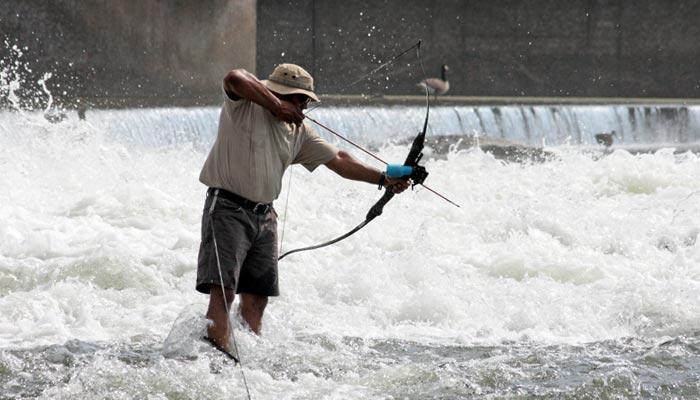
Before you can get out bowfishing, you need to have the proper gear. Here's what you will need to get started.
Getting into bowfishing may be a good excuse to buy a new bow, but you don't have to. Many archers use the same bow for fishing as they do for big-game hunting. And using your bowfishing time to become familiar with your regular hunting bow can pay off in the fall.
If your bow's a compound, cranking down the poundage is usually an advantage. Heavy bows usually aren't required, though there are some exceptions, such as when hunting alligator gar and big sharks, or when you expect to shoot targets more than a foot underwater. Bowfishing action is often fast and furious. A lighter draw weight allows quicker shooting and more shots before muscle fatigue sets in. It also lessens the headaches that occur when arrows strike rocks and stumps.
Another change you may have to make to your compound is the arrow rest. Fish arrows are typically heavier than hunting arrows and most standard bowhunting rests will not support them properly. Among the most popular for bowfishing is the roller-type rest, which spins as the arrow passes over it, and the collapsible type that moves out of the way upon string release.
Another option for compound bow shooters is to take the cue of most stick bow archers and lower their nocking point to shoot off the shelf. If you go this route, small pieces of carpeting or similar material should be glued to the shelf and sight window to provide cushioned pressure points for the arrow.
While compounds can work fine for carp, many bowhunters who normally shoot sighted compounds switch to stick bows and instinctive shooting for fish. This approach allows for quicker shooting and fewer equipment problems. Targets are always close and about the same distance away, and it's easy to get a knack for hitting fish instinctively.
The type of bow you use will determine your second important piece of bowfishing gearthe reel. If you've got a longbow or recurve with no accessory holes, you're pretty much restricted to using the traditional tape-on reel. This reel can be one of two types. Most popular is a spool about 4 inches in diameter that attaches to the front of the handle just under the arrow rest. The other is a large reel that the arrow passes through. You attach the reels to the bow by taping legs to the handle.
These simple spools serve only to hold the fishing line and keep it from tangling as you hunt and as the arrow departs. Line must be coiled by hand.
Modern bowfishing reels have advanced much in recent years. They range from very simple spools to fancy rigs with special retrieval devices. Among the most popular are units that utilize standard spincasting reels and a stabilizer hole mount. Some bowfishermen make their own from an old spincasting fishing rod handle, attaching a bolt that will fit the stabilizer hole to the handle butt. An alternate to heavy-duty spincasting reels is the Retriever from AMS, a reel that spools heavy line in a bottle for low-drag shooting. Some bowfishing reels have a dovetail mounting system that attaches to the bow's sight window holes. Most mount directly under the arrow, but some are side-mounted.
These reels store, dispense, and retrieve the link between the archer and the fishthe line. The type and strength required of this line varies 30-pound to 50-pound braided line is ideal for carp, up to 200-pound or even 500-pound for big saltwater species and alligator gar.
Some bowfishermen use Dacron monofilament, but most prefer braided nylon line because of its greater resistance to stretching and abrasion. Rising rapidly in popularity among big game bowfishermen is the new Fast Flight bowfishing line. Made of the same material as the premier bowstrings, Fast Flight offers the optimum in strength with less bulk.
Because standard arrows don't penetrate water well, you'll need a couple of fish shafts made of solid fiberglass, graphite, heavy-walled aluminum, or solid aluminum. They don't really need fletching, because shots are so short, but if there is fletching it should be waterproof. On the other end is a special fish tip, barbed to keep the fish from pulling off. There must be a means of easily removing fish from the shaftthe head must screw off or it must have movable barbs that you can fold down to slip off the fish. There are many different designs of fish tips, each with its own advantages.
The arrow must have an attachment for the line. This may be a simple hole drilled in the shaft, or a wire yoke that may or may not slide along the shaft. The best fish arrows have a steel cable the length of the shaft that the line attaches to and slides along. It allows the line to hang from the tip of the arrow at rest and slide to the back of the arrow during flight, which enhances accuracy.
Once you've assembled your archery gear, you'll need to set it up, try it out, and practice before taking a trip. Make sure the arrow flies straight and the spool feeds line smoothly. Practice close, downward shots, and keep in mind that light refraction makes underwater fish look shallower and farther away than they actually are. Some bowfishermen practice shooting with targets suspended just underwater.
Other useful equipment for bowfishing include polarized sunglasses, crucial for spotting fish underwater; a small billy club to dispatch fish; a stringer or container to hold fish; a jug, inner tube, or other float when you're after big fish. You'll also need hip boots or waders if you plan to bowfish on foot; and you will need a shallow-draft watercraft such as a canoe or johnboat, if you want more mobility.
Some serious bowfishermen use bass boats customized for bowfishing with an elevated platform on the front of the boat, or big johnboats with thick bottoms that can take the beating submerged rocks, logs, or mudbanks may dish out. Platforms are typically waterproof plywood supported by welded aluminum frames or ones glued up from PVC pipe and fittings. The higher the platform, the easier it is to see below the surface of the water and the less you have to compensate for refraction. Of course, high platforms also magnify the boat's motion and can make you wish you were back on shore.
Even if your main power source is a pole, paddles, or trusty outboard, don't overlook the advantages of an electric trolling motor. These days, it's hard to find a boat at a bowfishing shoot that doesn't use a trolling motor to search out and sneak up on underwater prey. Almost as popular are the foot pedal controls that let a single bowfisherman guide the boat with bow in hand.
Finally, don't forget a fillet knife, cooler, and maybe a smoker. While bow-taken fish are often used only as fertilizer (which is fine with natural resources officials, who consider carp and most other rough fish detrimental to gamefish and the waterways themselves) there is a better way to utilize at least part of your catch. Almost any fish taken in unpolluted water can be good eating if cleaned quickly, kept cool, and prepared correctly.
At Sportsman's Guide, we love to fish. Trust us for all your Fishing Gear, including Fishing Rods, Fishing Reels, Fishing Lures and more.